Thursday, February 28, 2013

Dreaming Of Sakura...

Little TF, Mr. TF, and I leave Japan with a mixture of sadness and peace.  Sadness, because the life that we spent three years building is over.  Peace, because we know that, in living here, we did our best.  Little TF and I saw just about everything on the island of Honshu that there was to see.  Mr. TF covered Okinawa for us.  I took a baby TF on every trip that I took- a port call visit to see Mr. TF in Thailand, a girls' trip to Seoul, a nuclear evacuation to Guam and the States, and a sightseeing trip with my mom and brother to Taipei.  We celebrated the ends of deployments with family trips to balmy Vietnam and Malaysia, and choked on putrid, chilly smog in Beijing. Mr. TF flew earthquake relief missions to the Tohoku region and joined the Australian military for exercises in the Outback.  Little TF made special American and Japanese friends at her preschool, and stole the hearts of our neighbors.  I did my best to learn how to live in our neighborhood and learn (very poor) Japanese.  We leave with full hearts, grateful for the resources and incredible opportunities that we were given to explore our corner of Asia.  We set our faces towards our homeland, with no regrets about our time in Japan.

 I leave Japan, though, with one yearning unfulfilled...I will not see the sakura bloom this spring.  If you're in Japan at the end of this March/April, would you go see some cherry blossoms for me?  I have two favorite places that I think you'll really like.


My first favorite place for ohanami, or flower-viewing, is really any local park in Japan. On the weekends, the parks will be packed; to avoid the enormous crowds it's best to go during the weekdays.  Everyone with a lunch break will still head out to relax under the fluffy white trees, but there will be more space to stretch out and enjoy the views.

To properly celebrate ohanami, a picnic is a must.  I recommend cherry blossom tea from Lupicia, fresh strawberries, and some sakura mochi, of course.  Toss in a couple bento boxes and a blanket, and you are all set!  


As you lounge, munch on snacks, and watch the wind swirl delicate sakura petals into the sky, don't be surprised if you are invited to join one of the local groups of partygoers.  In fact, as a foreigner (especially if you are female), you can pretty much count on it.  Ohanami seems to loosen up the normally formal and reserved Japanese and bring out a surprising amount of English-  perhaps it has something to do with the copious amounts of beer that go hand in hand with ohanami parties.  

On one particularly memorable day, my friend and I were invited to join a group of bamboo flute students and their teacher.  The men were taking a break from their class to appreciate the sakura.  After plying us with sticks of yakitori (grilled chicken) and Sapporo beers (yes to the chicken, no thank-you to the beer), the class got up and gave us an impromptu concert under the trees.  The haunting, breathy notes of the bamboo flutes, played to the tune of Amazing Grace; caught up by the breeze to dance with the cherry blossom petals, remain one of my most special memories of Japan.  

So grateful that they shared their day with us.
The sheet music for the bamboo flutes

You have to head to Tokyo for my other favorite sakura-viewing location- Yasukuni Shrine.  Yasukuni enshrines the over two million souls of those who died for the imperial family of Japan, including women, students, soldiers, and kamikaze. As such, it is also Japan's most controversial shrine.  Yasukuni Shrine is also of note for another reason...Tokyo's official Sakura Tree is located within the shrine's environs.  Tokyo's cherry blossom season does not officially start until this tree is in bloom!   


Go at lunch time and grab food at one of the many booths that crowd the avenue below the shrine. I recommend the takoyaki (fried octopus balls) and sakura-flavored ice cream!

Yasukuni's massive, torii-gated entrance


Pass through the shrine's gates, which are crested with the Imperial Chrysanthemum, and walk into a dream.  Every tree inside the gates is a sakura tree, and their delicate pink clouds fill the entire space.  The cherry blossom- which symbolizes the beauty and fleetingness of life- is also a metaphor for the kamikaze pilot, whose brief life was short, but made beautiful in his service to the Emperor.  During WWII, the Japanese government even propagated the idea that cherry blossoms were the reincarnated souls of dead soldiers.  


You can't miss Tokyo's Official Sakura Tree- it stands next to the shrine's Noh stage and is surrounded by a bamboo fence and photographers.


After you leave the shrine, stroll back through the torii gates to the bottom of the avenue, and then head up the bridge and cross over the street to the Chidorigafuchi Senbotsusah Boen gardens and surrounding moat.  Expect this park to be packed at all times during cherry blossom season.  


To escape the crowds, rent a boat and drift under the sweeping sakura branches that dip into the water.


 So, Japan, this is the end.  Thank-you for teaching me to appreciate the moment through tea ceremony. Thank-you for giving me a small taste of what it feels like to be a minority- I will take that greater awareness to my own country.  You showed me, through the earthquake, that life is a gift and can end at any moment.  I will always be grateful that you send me through the rest of my life with the knowledge that nothing truly worth doing is easy.

I promised Little TF that I will bring her back to visit her early childhood, someday.  Preferably after you get that Tokai Earthquake out of your system.  So I do not say sayonara- good-bye.  Instead, I leave with mata oai shimasho- see you, again.  


A special thank-you also goes out to my English students, and one very dear friend (you know who you are).  Thank-you all for being my fact-checkers, explaining Japanese customs and ways of thinking, and making sure I got to where I needed to go.  You taught me more than I could ever teach you.  


Yasukuni Shrine is accessed via Kudanshita Station on the Hanzomon, Tozai, and Shinjuku Subway lines.  Boat rentals in Chidorigafuchi Senbotsusah Boen are daily, from sunrise to sunset, and go from early April to late November.  

Disclaimer:  I do my best to make sure all my information is accurate.  However, details may change or I may just be flat-out wrong.  Please let me know if something needs a correction.  Thank-you!

Thursday, February 21, 2013

It's Time To Move On...

Our apartment is almost empty.

In Japan:
A few remaining boxes, rolled-up rugs, and the porch furniture on the roof- that we never ended up using because Japan's swampy summers are too damn hot- are all that remain.  The car is sold.  Little TF is attending the last day of her beloved preschool.  We have moved back into the Navy Lodge for the quickly fading remainder of our time here.  Our safety deposit is going to be returned- hopefully mostly intact.  Neighbors and the veggie man down the street will soon receive reluctant, good-bye bows.

In the United States:
Our old car, that we left in a California storage facility, has arrived at our new destination on the East Coast.  We close on our first home in March.  Little TF's already been accepted into a preschool for next year, and can even finish out this school year if she wants.  My brother is getting married this spring, and we've got a bridesmaid dress and a flower girl dress hogging space in our luggage.  Mr. TF has been slated for a mid-spring deployment, and Little TF and I have summer plans at my parents' house to prove it.

Those of us who answer the military's call, for whatever reason that may be, slip so easily out of one life and into another.  It only takes a couple weeks to completely pack up our lives and send them somewhere else. At the same time, it's not so easy. My family has spent the last three years building a beautiful life in Japan.  Deployment stress, natural disaster stress, not speaking the language stress, it all became less and less stressful until it became...normal?  (Well, not the natural disaster stress.  I'm still holding my breath against the looming Tokai Earthquake until our airplane wheels leave the ground.)  Walking to the grocery store every day, chatting in fragmented Japanese with our local flower vendor, listening to the children singing at the preschool across the street, catching a view of Mt. Fuji as I hang out the laundry...that's all become normal, too.  I already miss it. 


Friends and family say, "You must be so excited to move back to the States!" And I am.  The United States is my home.  But I am a bit fearful that I don't quite remember how to be an American.  My English is sometimes a bit off...hearing a majority of only Japanese or broken English spoken means I have started to occasionally stumble over my grammar, and can't remember little-used words (What do we call that shelter that cars park underneath?  Two days later- carport!  That's it!).  American-sized food portions in restaurants look grotesquely excessive, and American cars look shockingly large.  From a distance, filtered through the lens of online news sources, it's sometimes hard to recognize my country. Have we always been this environmentally indifferent?  Tolerated such poor education in so many of our public schools? Screamed this loudly about our gun rights? Been so excessively loud in general?  Or has the distance just made the indifference and the screaming and the noise seem more acute?  Also, shoes in the house?  Why do we stubbornly adhere to such a filthy habit?

But it's time for us to go back.  It's time for my daughter to learn how to be an American.  Time for her to learn that to thank someone, Americans look the person in the eye instead of bowing towards the ground.  That to gain and extend trust, Americans extend a confident handshake.  That to become an American, one need only to possess the desire (although I suppose some would also argue for legal entry) to do so.  That a person may personally have the freedom to be a bigot and judge by skin color and cultural background and sexual orientation (I advocate none of those things), but our governments, businesses, and schools do not have such a freedom.  These are good things that my daughter needs to learn and I am proud that she is a citizen of a such a country.

As we close the last page of the book, Three Years In Japan, we have already started to open the first page of our First Year On The East Coast book.  Every military family has a stack of such books.  These are rich, difficult, fascinating tales, and everyone's books are different.  Yet, somehow we are all writing the same story, wherever in the world we might be.  In leaving Japan, we have friends that are leaving our book's pages.  In moving to the East Coast, we have old friends that are rejoining our story. We say a reluctant "good-bye" and then a "good to see you, again," practically in the same breath. And so the military moving cycle continues.

We will always be grateful that our stack of books included Japan.


Disclaimer:  I do my best to make sure all my information is accurate.  However, details may change or I may just be flat-out wrong.  Please let me know if something needs a correction.  Thank-you!

Saturday, February 16, 2013

A Day For Girls!

If you're in Japan right now, swing through your nearest department store!  Displays for Hinamatsuri- literally translated as Dolls' Festival and more commonly known in English as Girls' Day- are everywhere.  Celebrated on March 3, the displays that pop up in February are one of the first signs of impending spring.  Pink!  Cherry and plum blossoms!  Elaborate doll displays!  Even grocery stores get in on the fun and sell special treats and snacks.  

Traditionally, families with a daughter in the house set up a beautiful doll display, like the one pictured below.  The prince and princess preside over the top level, with courtiers, attendants, and court accessories gracing the descending steps in order of importance.  Doll sets at our local department store include anywhere from just a prince and princess, to three or four steps of lesser dolls.  The prices are eye-popping, starting from the equivalent of a few hundred dollars to several thousand!  Of course, the larger the doll set, the harder to find space in a tiny Japanese apartment.  Several Japanese friends have admitted to not having the space to justify such a purchase, and mark the day with a very tiny display, instead.


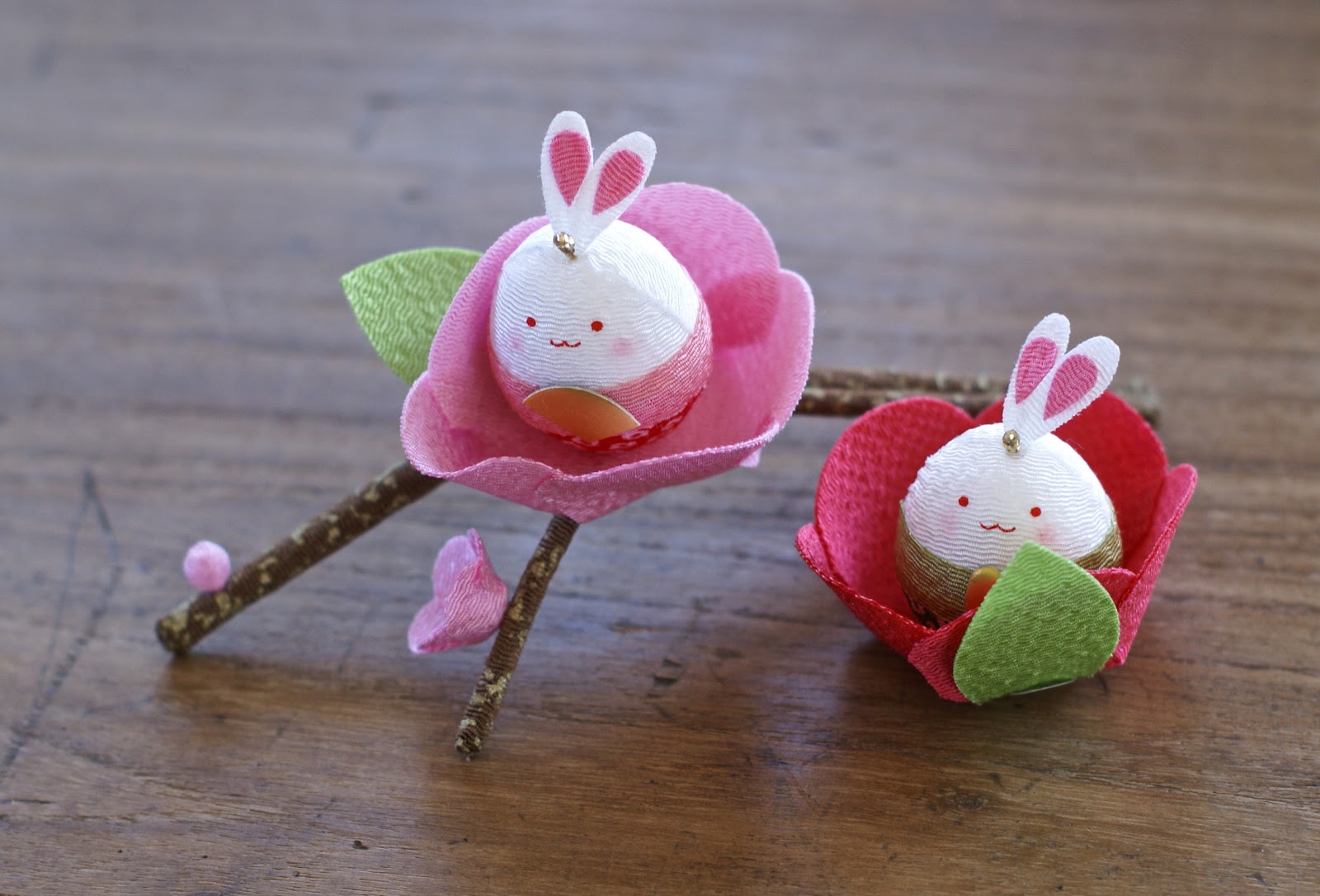
Wanting to get on the Girls' Day fun, but not wanting to burn the cash on a display that would cost more than all of our Christmas decorations put together, I found this little fabric Hinamatsuri set at the mall chain store, Oribe.  Oribe sells traditional Japanese dishes, chopsticks, tea utensils, kimono-patterned bento boxes, and seasonal decorations.  Oribe's adorable Girls' Day display drew us in, and Little TF and I both decided that the adorable bunny prince and princess sitting on little plum blossom thrones needed to come home with us!


As a lover of all things pink, Little TF declared the pink bunny princess to be a personification of...herself.  She then declared the bunny prince to be me.  "But I can't be the red bunny!  That's the prince," I protested. "No, Mama, that's not a prince, that's the red princess (duh)."  Upon reflection, I realized that since there are no girls making an appearance on the boys' holiday in May, it's not really fair of the boys to muscle in on Girls' Day.  Two princesses it is, then!


If you set out a Hinamatsuri display for your daughter, tradition dictates that you pack it up at the end of the day on March third.  Otherwise, a no-longer-quite-so-horrifying superstitious belief predicts that your daughter will get married late.  


Disclaimer:  I do my best to make sure all my information is accurate.  However, details may change or I may just be flat-out wrong.  Please let me know if something needs a correction.  Thank-you!


Friday, February 8, 2013

Tea Time in Ginza

With our time in Japan coming to an alarmingly fast end (sad face), Monday was the time for our lovely Spouse Club to say good-bye to me and several other ladies.  Many of our former members have chosen to have their farewells at more local restaurants and karaoke bars, but my fellow farewell-ees and I decided that a trip to Tokyo sounded much more fabulous! 

While karaoke bars definitely have a time and a place, we were in search of something a bit more...classy.  And what could be more classy than one of the most sophisticated hotels in Tokyo's classiest district- Ginza?  Enjoying the Peninsula's high tea sounded like just the thing!


Scones and sweets

Our menu was as follows:


The Peninsula Classic Afternoon Tea Set
2:30 pm to 5:00 pm

Selection of Savories

Fried Turkey Wrap Roll with Cocktail Sauce

Corned Beef, Sauerkraut and Watercress on Wheat Toast with Mustard Sauce

Salmon Rillettes with Multigrain Crouton

Apple Purée with Anis, Fresh Cheese and Sliced Almond


Selection of Sweets
Cheese Cake Chocolate Tart Strawberry Short Cake Matcha Cake

Scones (plain and raisin)

Choice of tea

The Peninsula Tokyo Blend Tea

The Peninsula Tokyo Afternoon Tea

The Peninsula Tokyo Breakfast Tea

Assam, Darjeeling, Earl Grey, Muscat, Jasmine Peppermint, Chamomile, 
Lemon Verbena, Rosehip & Hibiscus Relax Therapy, Counseling


I enjoyed the Lemon Verbena and Peppermint, other friends enjoyed the Rosehip & Hibiscus and Afternoon Blend, and one particularly brave lady decided to give Counseling a try.  She couldn't stop talking about how great it was, and how everyone should try Counseling at some point in their lives.  Several of us also sampled the Muscat, which had a fantastic grape smell and horribly bitter taste.  I do not recommend the Muscat.

As we chatted and sipped and snacked, a live piano/bass duet serenaded us from a balcony, and the lights of the Peninsula's magnificent lobby chandelier twinkled above our heads.  What a delightful way to say good-bye to some lovely ladies, and to Ginza.  Sayonara...for now!


Afternoon Tea at the Peninsula is 3,600 yen per person.  Reservations are recommended, and can be made by calling The Lobby at (81-3) 6270 2731.  Dress code: Smart Casual.  Sandals, shorts, and tank tops are not allowed.


Disclaimer:  I do my best to make sure all my information is accurate.  However, details may change or I may just be flat-out wrong.  Please let me know if something needs a correction.  Thank-you!
Monday, January 28, 2013

A Taste Of Spring And Cherry Blossoms

While patches of snow linger on the ground and wintery plum blossoms have yet to show their faces, I have been stalking my local wagashi shop, since the New Year, in anticipation of the first culinary signs of spring.  We may be moving before Japan's peerless cherry blossoms make their fleeting appearance, but I am nonetheless determined to at least taste them.  This week, the shop finally had what I've been looking for...sakura mochi.

My local wagashi shop adds a special touch to their sakura mochi...a pink, pickled cherry blossom.  Kawaii!


Traditionally eaten on March third's Hinamatsuri, or Girls' Day, sakura mocha are made of sugar, glutinous rice flour, red bean paste, and a dash of red food coloring.  The little package is then wrapped in a pickled sakura leaf.  This perfect combination of lightly sweetened mochi and lightly sour leaf promises that spring truly is around the corner- even if the unheated hallways of my Japanese apartment are still the exact temperature as my refrigerator.  Little TF is almost as enthusiastic in her enjoyment of sakura mochi, although whether it's because she likes the taste or the pink color, I haven't quite established.

In the Kanto area, sakura mochi is most commonly made in the Tokyo-style, as seen in my above photo.  The slightly different Kansai-style sakura mochi hail from the Kyoto region, and are made with a much more lumpy rice batter.  I usually see the Tokyo-style sakura mochi, but I've also spotted the Kansai-style at my local grocery store, as well!


When I dream of Japan, years from now, I will dream of Kappabashi...summer festivals...Miyajima...takoyaki...floating cherry blossoms...and sakura mochi.

Friday, January 25, 2013

"Enjoy Mop Walking!"

I have a love/hate relationship with the flooring in my Japanese apartment. Its wood (laminate) flooring has to be vacuumed and mopped- always.  Toss in a very messy three and a half year old kid, and my floor is a never-ending time suck.  Vacuum, mop, vacuum, mop, rinse, repeat. 

My floor is tied with my sink full of dishes- that need to be hand-washed- for my most hated household chore (Japan, get with the program.  By 2013, you should be past mere dishwashers and on to personal dishwashing robots).  Having spent my childhood and early adult life in entirely carpeted homes, at first I really really hated the constant attention my smooth floor demanded of me.  Dust balls pile up, crumbs scatter, and, with two long-haired women in the place (Little TF and me), there's a lot of hair for the vacuum to deal with.  I just didn't remember my mom's wall to wall carpet getting dirty so quickly! Until I realized that....carpeted houses aren't somehow magically free of dust, crumbs, and hair.  Carpet just hides all that nasty stuff more effectively.  GROSS.  

So, onto the "love" part of my smooth flooring. Once I realized that easily spotted dirt means a more effective floor cleaning, hard wood floors (can I graduate from the laminate, someday?) became my number one requirement for any future houses.  I may have to constantly clean my floors, but at least I know they are clean!

Let's be real, though.  Mopping the floors every other day is not my idea of a good time.  And different areas of flooring are not created equal. The dining area and hallways may still be pretty good, but my kitchen floor has gotten nasty.  Break out the mop, and I might as well clean every thing.  Which I'd rather not do.  So....I might skip the mop altogether.  I'm a bad housewife, what can I say?


But if I had these fabulous, Japanese cleaning slippers?  I could mop the kitchen floor while cooking!  I could mop the floor behind the vacuum! Little TF would freak out and demand her own, ridiculously cute pair!  Maybe I could miraculously find a set big enough to fit Mr. TF's enormous man feet!  My apartment could be mopped into spotlessness at all times.  MUST. BUY. THREE. PAIRS.


I've seen cleaning slippers sold at 100 yen stores.  These particular animal slipper friends were spotted at Tokyu Hands, Machida.  They have just topped my list of what needs to come back with me to the States!


Disclaimer:  I do my best to make sure all my information is accurate.  However, details may change or I may just be flat-out wrong.  Please let me know if something needs a correction.  Thank-you!


Monday, January 14, 2013

It's Face Mask Time!

Whether you are battling allergies to unfamiliar plant life, trying to protect your foreign immune system from exotic germs, or about to visit a city with a smog problem so severe that flights are being cancelled, your local Japanese drug store has got you covered!  Just swing by and pick up a pack of face masks!  

The number of masks per pack may vary- look for a number display near the top.  On the pack of kids' masks, the number in the top, right-hand corner indicates that this package contains three masks.

Japanese product labeling is usually so blatantly gendered that reading skills are completely unnecessary- here, pink and medium-sized masks are for women, while the blue and large-sized masks are for men.  Of course, the kid-sized masks are the smallest of all!

I looked for the masks with the highest and most prominently displayed percentages, assuming that the higher the number, the more efficacious the mask.  An email with this photo, sent to my Japanese friend, confirmed my hunch.  These masks are the most highly rated for pollen/germ/pollution protection.  We are ready for any air-borne hazards that Asia can throw at us!

Side note:  One of my students told me that there is an allergy in Japan that literally translates to "China Dirt Allergy."  As in, China has deforested so much of their country that the exposed earth is blowing to Japan and clogging up people's sinuses.  Oh, and it blows all the way to the States, too.  Which is...ummmm...good for people who like to ski in the Sierra Nevadas?


Disclaimer:  I do my best to make sure all my information is accurate.  However, details may change or I may just be flat-out wrong.  Please let me know if something needs a correction.  Thank-you!


Thursday, January 10, 2013

Almost As Good As Chicken Soup.

Mr. TF and I spent the entirety of last weekend coughing, shivering, sniffling, and wallowing in the general misery that is the common cold.  Our Caucasian immune systems were meant to stay on the other side of the world, so this delightful common cold was made a bit un-common with the additions of muscle aches and fevers.  Little TF spent the weekend keeping as much distance between her and her disgustingly ill parents, as possible.  It was an excellent strategy...she's not sick, yet (knock on wood)!

Of course, I turned to chicken soup (with homemade stock!) to combat the germs, along with chamomile tea and fresh lemon.  When I ran out of chamomile tea, I immediately turned to this jar of citrusy goodness- my yuzu honey tea from this past autumn's visit to Korea Town.  Sweet and soothing, I drank so many steaming mugs of yuzu honey tea that my jar is now almost empty.  Curious about what home remedies the Japanese use to combat colds, I texted my friend, "We've got chicken soup...what do the Japanese have?"  She texted back, "Porridge and yuzu honey tea."  


Porridge, I decided to take a pass on.  Yuzu honey tea, I was already doing!  The citrusy goodness was hard at work, soothing my hoarse throat, clearing my stuffy nose, and warming my feverish chills.  Perhaps there is a little Japanese in me, at last?


Big jars of this yuzu tea can be found in the grocery stores that stuff Tokyo's Korea Town, and even (rumor has it), Costco!  Made In Japan yuzu-flavored honey can also be found in Japanese stores (I've purchased it from a gourmet honey store in Kawagoe).  The Japanese type of yuzu honey can be added to hot water as well, but it doesn't have the delicious chunks of preserved yuzu that the Korean version has. If you are back in the States, this website sells chunky yuzu honey tea by the jar!  I had trouble finding it via Google search until I noticed a blurb on another website and changed my search parameters to "honey citron tea."  Ta da!  Korean yuzu honey!  I'm so excited that I will still be able to get my fix after our return to the States. Common colds, beware!

Disclaimer:  I do my best to make sure all my information is accurate.  However, details may change or I may just be flat-out wrong.  Please let me know if something needs a correction.  Thank-you!


Saturday, January 5, 2013

Look What I Found!

So do you remember my post from a few weeks ago, about my latest, exciting bento box find- a little washable hand towelette and squee-worthy bumble bee container of cuteness?  Tonight, I was wandering through a favorite bento blog when I discovered this gem of a website: en.Bento&co.com.  Shipping all over the world, from Japan, you can get your bento fix no matter where you live!  This ridiculously adorable bumble bee towelette container can now be yours!  


Bonus! Since Bento&co's stuff is all made in Japan, it's guaranteed to be BPA-free, because Japan is more on top of toxic plastics than Americans are and banned BPA in the 90's.  Someone stop me from ordering all the cute animal bento boxes for Little TF....


Wednesday, January 2, 2013

Japanese Grocery Store: Winter Produce!

I love January!  

A: My birthday is in January.  I'll be accepting gifts all month! 
B: My favorite Japanese fruits are in season! 

Although, now that I think about it, I love June and peaches....October and kyoho grapes...November and fuyu persimmons...most months have delicious fruit, actually.  Winter fruit, though, makes me especially happy- cheerful, growing things are a good reminder, as I shiver in my Japanese refrigerator apartment, that winter here is not actually as severe as it feels.  So, what's new at my local grocery store?

Yuzu!


I learned about yuzu when we moved to Japan.  This aromatic Asian citrus is much more hardy than its distant Florida relatives, as it ripens in cold December and can tolerate below-freezing temperatures. Arriving in Japan, from China, around one thousand years ago, yuzu is a popular flavoring in many Japanese dishes, and it even makes an appearance in the traditional, Japanese bath.  On the night of the winter solstice, bathing in a tub filled with bobbing yuzu is supposed to bring one good health.

My neighbors have yuzu trees in their gardens, and catching sight of the bright yellow orbs always perk me up on a chilly, grey day!  In addition to being pretty, yuzu are also delicious.  More of a seasoning than a snack (like a lemon), I used some yuzu peel in a cabbage dish last week, and I'm planning on using the rest to make my favorite winter drink- yuzu tea.  Yuzu, with its rough, mottled surface, can sometimes look a bit like an orange, so I always sniff one to make sure I'm buying the right fruit.  Yuzu have an intense scent, and smell, to me, like someone crossed a grapefruit with a pine tree.  It's a sharp, clean smell. I'm already scouting online greenhouses for a supplier of yuzu trees, because my American garden is going to need one!


Kumquats!


I love cute, little kumquats, and their Japanese name- kikan.  The name for mandarin oranges, in Japanese, is mikan.  In kikan, the mi of mikan is switched to ki, which is written with the character for "gold."  Cute fruit and cute name!  Kawaii!  I eat kumquats like candy, slicing them in half to squeeze out the seeds, and then popping both tiny halves in my mouth.  Their skin is very thin and edible, and the taste is very sweet and tart.  I also like to thinly slice them and toss them on a salad with a balsamic vinegar dressing.  Delicious!


Strawberries!


You haven't had a strawberry until you've had a Japanese strawberry.

I say this as someone whose mother who dragged her children to Michigan strawberry fields to squat and pick for hours, in the beating sun, because it was "fun."  I've eaten more freshly picked strawberries from the vine than I care to remember.  I don't know if it's because Japanese strawberries ripen in  winter, or if it's because they are grown on raised beds and never touch the ground, but Japanese strawberries are incredibly, almost supernaturally sweet.  And, bonus: the raised beds mean no more bending and squatting to pick them (I love you, Mom).

I will buy a pack every time I go to the grocery store, from now until we move in March.  We just can't get enough strawberries!  I always set some aside for Mr. TF, and then Little TF and I gobble down the rest of the pack as soon as I can get them washed.  Poor Mr. TF still doesn't get to enjoy many strawberries when he gets home from work; somehow, Little TF wheedles most of them away while he eats them. I guess he should probably go buy his own.

Strawberries are especially popular with Japanese women, as their high vitamin C content is said to beautify the skin.  Another great reason to eat Japanese strawberries (as if I needed another one)!  Strawberries are probably the most expensive of my favorite winter fruits, but my local grocery store still sells them relatively cheaply, which is a relief.  Little TF's and my strawberry-eating habit is serious!  We now also like to eat them the way you will if you pick at a Japanese green house- by dipping them into a can of sweetened, condensed milk. Oishii!


Disclaimer:  I do my best to make sure all my information is accurate.  However, details may change or I may just be flat-out wrong.  Please let me know if something needs a correction.  Thank-you!


Tuesday, January 1, 2013

Today's Photo! (Snow Monkeys)

It's snow monkey time in Nagano...

Jigokudani- Hell's Valley- is the home of Japan's famous snow monkeys.
This little guy's spa treatment was so relaxing that I was able to get super close!


Disclaimer:  I do my best to make sure all my information is accurate.  However, details may change or I may just be flat-out wrong.  Please let me know if something needs a correction.  Thank-you!


Monday, December 31, 2012

Happy New Year!

Akemashite omedetou gozaimasu!  Happy New Year from Japan!  While the Chinese have said farewell to 2012 and their luckiest year- the Year of the Dragon- the Japanese are saying hello to 2013 and their luckiest year- the Year of the Snake.  

Thank-you, readers, for joining Little TF and me on our adventures during this past year.  We wish you all a wonderful 2013, wherever you may be in the world!

My neighborhood wagashi shop was selling snake-themed New Year treats this week.
Of course, one of them had to come home with me!  


Disclaimer:  I do my best to make sure all my information is accurate.  However, details may change or I may just be flat-out wrong.  Please let me know if something needs a correction.  Thank-you!


Thursday, December 20, 2012

Yuletide in Yomiuriland


We're one week into Little Tofu Fox's three week, Christmas/O-shogatsu vacation.  When I picked her up last Friday afternoon, I was super excited to have my kid home for three weeks; by Tuesday, she was already begging me to go back to preschool.  Preschool is either that awesome, or I am that lame.  I choose to believe the former.

In the middle of Tuesday morning's epic, breakfast "I want to go back to preschool"whining episode, just as I was realizing that we still had two weeks and six days of vacation to go, Mr. TF reminded me that he would be flying late that night.  Little TF and I looked at each other in horror.  No one to save us from each other?  All day?  I decided upon an early activation of the Christmas Break Emergency Entertainment plan: a trip to Yomiuriland!


In the beginning of December, I asked one of my students which Tokyo Christmas illuminations she most recommended.  She named the Tokyo Midtown lights, and  Jewellumination- the light displays at the Yomiuriland amusement park.  "Yomiuriland's lights have been done by a very famous light designer," my student added, "The park is located off the Odakyu Line."

I take the Odakyu Line all the time, and was surprised to hear of an amusement park nearby.  I've been passing roller coasters for almost three years and never noticed them?  Geez, I really need to stop checking Facebook on my phone and look out the train windows more often!  Since Mr. TF wasn't going to be home till late that evening, I decided it was the perfect time for Little TF and I to have some mother/daughter bonding time while enjoying amusement park rides and Christmas lights.  Our stuck-at-home crisis averted, we waved good-bye to Mr. TF, packed a lunch, and took the train to the Odakyu Line's Yomiurilandmae Station!


Mae, in Yomiurilandmae Station, means, "in front of."  Street corners in front of landmarks- such as  schools- will often have a street sign that says Nameofschoolmae.  In front of such-and-such a school.  So, I didn't even bother looking at Yomiuriland's English website for directions.  This one was going to be easy!

Or not...


After getting off at Yomiurilandmae Station and looking around, I had a realization.  The reason I have never noticed an amusement park as my train shot past Yomiurilandmae Station, is because Yomiuriland is not, in fact, in front of the station.  Not even walking-distance-in-front-of the station.  After matching my limited Japanese reading skills to the Japanese-language-only map outside the station, I realized that we would have to take a bus to Yomiuriland.

As previously discussed in other blog posts, I hate taking buses with Little TF.  The stroller has to be unpacked  (why do I stuff so many empty drink bottles in the basket?!) and folded, and prayers have to be said for an empty bus seat for Little TF. She's still a bit too young to balance on a careening bus, and I'm too busy trying to keep her folded stroller from smacking into an elderly person to safely keep her on her feet.  Also, bus schedules are never in English.  Never, ever, ever.  So unless I already know exactly which bus to get on, and which direction in which to go, we will circle around on buses for hours.  It's just the kind of situation that sets foreigners up to look dumb, confirming any and all Japanese stereotypes, which I generally try not to do.  So, for all of the above reasons, I avoid buses like the plague.


This time, however, I had no choice.  Fortunately, my very limited and very deplorable Japanese reading comprehension has advanced just enough for me to decipher the characters for Yomiuriland on the bus timetables. Much laborious kanji checking and painfully slow katakana reading later, I confirmed the  proper bus number.  We crossed the street (dragging the stroller up and down the stairs-only pedestrian crossing bridge...was nothing about getting to Yomiuriland going to be easy?) and found our bus stop.  Since it was a school day for older Japanese kids, we were apparently the only ones going to Yomiurilandmae at one o'clock in the afternoon.  We boarded a very empty bus and each found a seat.  Finally, an easy part!


Three stops later, we got off at Yomiuriland.  The empty bus was an accurate predictor of the situation at the park...we practically had the place to ourselves!  A few families with young children, and small groups of young people were wandering around, but that was it.  Little TF and I could hardly believe our luck!  We went on ride after ride, sometimes four or five times in a row, and were usually the only people on them.  Little TF also enjoyed the mostly empty sea lion show, twice.  Yomiuriland is a little old and shabby in the daylight, but Little TF didn't care and we had a great time riding the classic amusement park rides that I enjoyed as a kid.


Dusk approached and the crowds began to arrive.  We were in the middle of riding the child-size "roller coaster" when sudddenly all the lights turned on!  Every inch of Yomiuriland lit up. The landscaping was blanketed, the roller coaster tracks were outlined, the cars on the spinning rides were festively decked out, and the ferris wheel was bathed in a spectrum of color.  Little TF had already decided that we were having a much better day than previously expected, so the added bonus of so many beautiful Christmas lights made Mommy a hero.  Ha!  Take that, preschool!


The water park section of Yomiuriland was closed during the day (how did I not know about the water park during this past sweltering summer?) , but opened at night for special waterside illuminations.  It was spectacular, especially the waterfall of lights spilling off the tallest water slide!


What's more fun than getting dizzy on amusement rides during the daytime? Getting dizzy on rides at night, while surrounded by Christmas lights!  Little TF and I went on a few more rides and munched on hot pretzels while watching dance troupes perform Christmas routines, before I judged that rush hour on the trains had probably settled down enough for us to head back home.  Little TF managed to get the last seat on the return bus, and then we scrolled through photos of our fun day as our train zipped us home.  Day two of Christmas break was declared a resounding success by all.  Only two more weeks to go!

Pray for me.


Yomiuriland's Jewellumination is running from now until February 17.  Visit the Yomiuriland website for a link to the English page.  Different types of tickets are available, depending on the ages of any children and how many attractions you want to enjoy.  The English page also has a discount coupon that can be printed out.  If you are going only to see the lights, there is also an admission-only ticket available for purchase.  Since Japanese schools are now on winter break, expect bigger crowds during the daytime.

Directions:  Take a local train on the Odakyu Line to Yomiurilandmae Station.  Exit on the north side of the station to avoid having to take the stupid, stairs-only pedestrian bridge.  Look for the bus stop next to the police box, at the bottom of the pedestrian bridge, and board the #1 bus.  Yomiuriland is only a few stops away!


Disclaimer:  I do my best to make sure all my information is accurate.  However, details may change or I may just be flat-out wrong.  Please let me know if something needs a correction.  Thank-you!

Tuesday, December 18, 2012

New Book: Japanese Farm Food

Since my Miyajima posts won't be ready for a bit (apparently I took a lot of photos), I decided to quickly wrap up this cookbook review that has been sitting in my box, half-finished, for far too long.  It may be too late to order in time for Christmas, unless you're a lucky reader in the States with access to Amazon's two day shipping and a fully functioning post office.  In that case, you should probably just open another web page and order this cookbook before we continue any farther.  It's that good.


I call it a cookbook, but Nancy Singleton Hachisu's Japanese Farm Food is more than that.  Toss in some old, Japanese farming techniques; discussions of antique furniture; the mixing of Japanese and American families;  appreciating the seasons through food; how Shinto beliefs influence the family's life and traditions; the tension between history and modernity; and, yes, delicious recipes; and what we have here is a diary/theology/family tree/travelogue kind of cookbook.  Japanese Farm Food is even a work of art, with its exquisitely bound cover and gorgeous photography stuffing the pages.  When it first arrived in the mail, I couldn't put it down for days.


Most of the recipes in Japanese Farm Food are almost laughably simple, using three to six ingredients, at most.  This is, to me, the genius of traditional, Japanese cooking.  The individual flavors added to a dish can be appreciated, while enjoying the flavor of the dish as a whole.  Nothing is overwhelmed or too strong...nuance can be thoroughly savored.  I'm excited to make the cabbage and yuzu dish (pictured above) to go with this evening's meal!


There is an excellent section on fish, with discussions about sashimi, crab, salmon, and clams. However, as this is a book about farm food in Japan, most of the recipes are unapologetically cheap to recreate, with many dishes hinging on vegetables.  Other Japanese classics such as curry rice, teriyaki chicken, and udon have also been included.  Mmmmmm...curry rice!


Hachisu also talks about how her husband revived the family business, returning to time-honored farming techniques that are disappearing from Japan.  Their 80-year-old family farm house is essentially the most important member of the family, sheltering and watching over the mixing of generations, cultures, and culinary traditions.  Some tension is apparent as Hachisu muses over her life as it has evolved in Japan, which I appreciate.  It can be hard to find the balance between having a good attitude and also admitting that this living overseas thing is sometimes flat-out miserable.  I'm glad she doesn't gloss over her struggles.


One of my favorite sections is visual references for cooking techniques.  That's how egg is added on top of katsudon!


There is also an excellent reference section in the back for sourcing ingredients when back in the States.   Thank-goodness, because otherwise, I'm going to have to plant a yuzu tree in my backyard once we move to the East Coast.  There are some foods I can no longer live without!


I love getting to peek into Hachisu's family as I flip through the gorgeous pages of this cookbook.  Her purist farmer husband, her lively boys, her hard-working mother-in-law, and her happy English students are all fascinating characters within this Japanese cooking story, and their stories are woven throughout.  Hachisu reminds me that no matter how long one lives anywhere, there is always more to learn.


Japanese Farm Food, by Nancy Singleton Hachisu, can be purchased on Amazon.  Thanks to a friend who found this book and told me about it.  


Disclaimer:  I do my best to make sure all my information is accurate.  However, details may change or I may just be flat-out wrong.  Please let me know if something needs a correction.  Thank-you!